






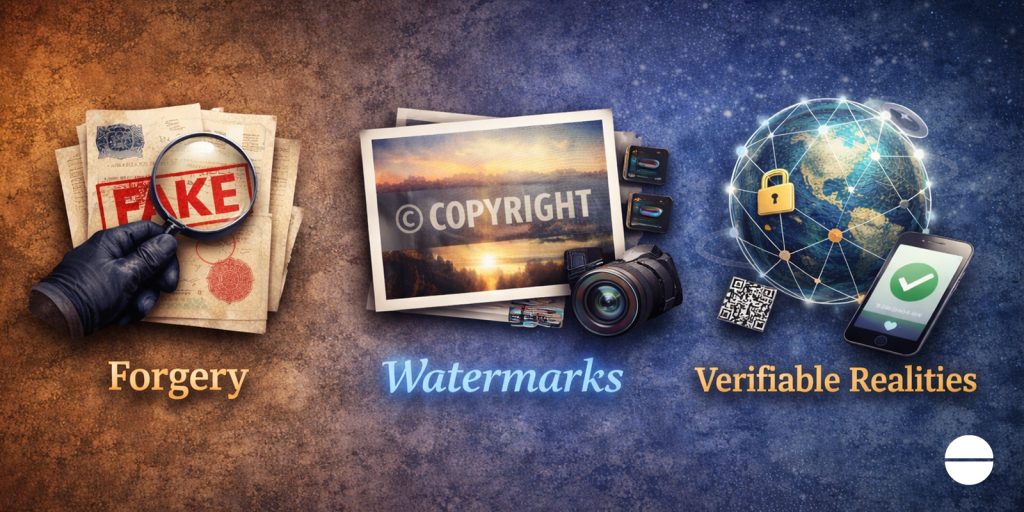
Forgery, Watermarks, and Verifiable Realities
-
- December 24, 2025

“Disaster looms if AI advances faster than our ethical decisions.”
— Emmanuel Apetsi
A dual-edged miracle shapes every era. Gunpowder armed both conquerors and defenders. Electricity powered factories and execution chairs. The printing press democratized knowledge, but also enabled counterfeiters. Photography preserved reality until manipulation crept in. Now, Artificial Intelligence (AI) emerges as the latest forger, crafting convincing media that challenge our sense of truth. In this era of technological evolution, a crucial truth stands out: only by mastering the art of verification can we uphold the authenticity of reality.
In the early 2000s, digital cameras were novelties. Most misinformation was crude Photoshop jobs or easy-to-spot scams. Tools like reverse image search were simple barriers against recycled fakes. But then, within just two decades, generative models evolved into tools capable of synthesizing voices, faces, and entire scenes that are indistinguishable from reality. Clumsy deepfakes gave way to seamless videos, static images to dynamic worlds.
Since then, the information ecosystem has shifted from scarcity to abundance. Today, I lead Skylake AI, building truth intelligence systems that safeguard authenticity in a world drowning in synthesis. Generative AI amazes us all, but it also means billions of people face media where real and fake content are harder to tell apart every day. What will reliable information look like in the near future? How do we handle a world where convincing forgeries keep getting better?

These threats aren’t hypothetical; they’re already reshaping the financial world. In 2020, a manager at a Hong Kong-based branch of a Japanese firm received a call from someone who sounded exactly like the company’s director. Backed by convincing forged emails and legal documents, the “director” instructed the manager to transfer $35 million for a supposed secret acquisition. The authenticity seemed unquestionable, and the funds were sent across multiple accounts before follow-up verification revealed the fraud. The scam succeeded, exposing how easily trust can be weaponized in the absence of robust verification tools.
Fast forward to 2024, and the stakes and sophistication had grown. An employee at the Hong Kong office of a multinational firm was asked to join a video conference regarding a major financial transfer. On screen were the CFO and several colleagues, all appearing live and engaged. Unbeknownst to the lone employee, every other participant was an AI-generated deepfake. Convinced by the “live” interaction, the employee transferred the equivalent of $25 million. The deception was uncovered only a week later, after checking with the company’s headquarters.
These kinds of events show that as fake information becomes more believable, the risks to businesses and markets worldwide grow significantly. We can only hope to rebuild trust and stop manipulation on this scale if truth intelligence, and verifiable provenance are widely used.
This is a sure truth: the future is hard to foresee because it masquerades as the present. Early photographs were stiff portraits mimicking paintings. Early deepfakes had blinking errors or mismatched lighting, just like today’s models that still occasionally falter in complex motion.
With each passing day, the line between real and fake blurs further: a politician’s voice cloned for election interference, a celebrity’s face swapped into compromising scenes, news footage altered imperceptibly. The truth is, we remain in that uneasy transition, where human intuition falters at barely better than chance.
Here’s the crux: While it’s true that none of us has all the answers, history has equipped us with valuable lessons. By inviting a collaborative quest, we can build detection and verification at every scale, from individuals to organizations to societies. Together, we can innovate and strengthen our defenses against misinformation, combining our insights and efforts to ensure authenticity prevails.
Individuals: from locks to provenance
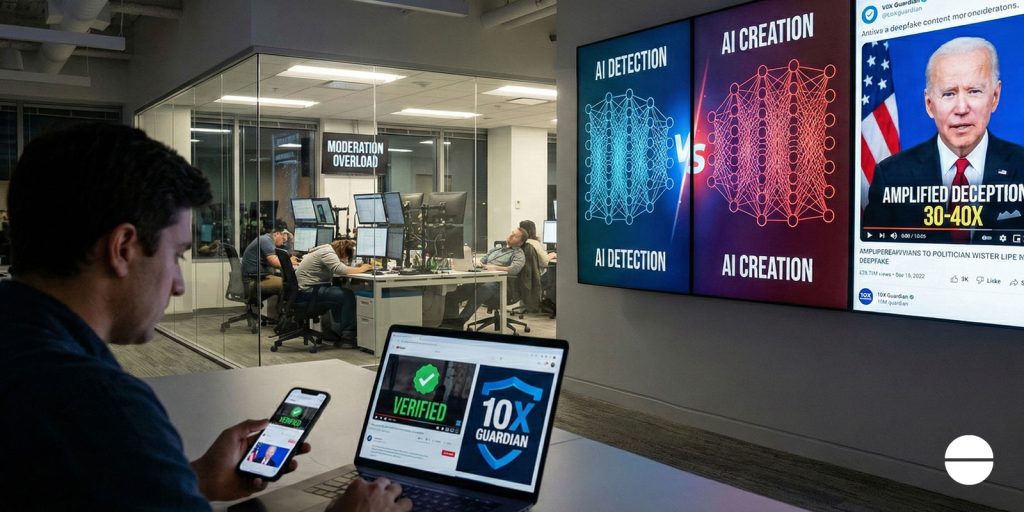
Leading organizations now use advanced AI tools to spot fake content faster than humans can. But as detection improves, AI for creating fake content gets better, too. A vigilant user with on-device tools can verify media in seconds, making them a 10x guardian of the truth. Yet a single overlooked deepfake can mislead millions, amplifying deception 30-40x, a new headache for social media giants, and I guess their moderation teams have had a good night’s sleep in a while.
In the Renaissance, art forgeries were identified by connoisseurs who examined brushstrokes. Later, watermarks and paper analysis provide invisible proofs of origin. Today, most personal verification remains lock-like: manual checks for artifacts, reverse searches. It’s like securing a house with deadbolts in an age where keys are forged instantaneously.
With truth intelligence, individuals shift from reactive locks to proactive provenance, cryptographic attestations embedded at creation and in transit.
When will everyone gain this? Two hurdles persist.
First, detection is fragmented. Some tools are good at spotting fake images, but struggle with video, audio, or text. One suspicious clip might show visual problems in one tool and audio issues in another, with context spread across a range of platforms. While people can connect these clues, machines need a unified system to do the same. Without secure, standard ways to track media from its source, detection will stay disconnected.
Second, verifiability erosion. Early deepfakes left artifacts: unnatural hands, inconsistent shadows. But here’s today’s reality: models now minimize these through vast training. Human detection hovers at coin-toss levels; even experts falter drastically as realism surges. We lack universal “tests” like code compilation, and ground truth blurs by the day.
We need systems that use invisible watermarks and trustworthy metadata to track media. Once this kind of proof is built in, people can move from doubting everything to trusting verified information, and eventually to feeds that check themselves automatically.
Organizations: vaccines and cryptographs
Media houses, platforms, and enterprises are modern inventions, yet they fracture under synthetic floods.
Decades ago, fact-checkers worked in small teams to debunk emails. Now, news outlets face millions of possible fakes every day, created by AI that never sleeps. Editors are overwhelmed, and trust is under pressure. We’re using old tools to fight a new problem.
But again, history points toward future defenses with truth intelligence.
First, vaccines. Before Jenner, societies reacted to outbreaks. Vaccination now trains immunity proactively, eradicating threats.
Truth intelligence is the vaccine for organizations. It preserves provenance across pipelines, surfacing forgeries without noise. The viral hoax needing cross-team verification resolves in moments. Platforms scale moderation without inevitable fatigue.
Second, watermarks. Medieval scribes embedded subtle marks for authenticity; later, currency used intricate designs to resist counterfeiting.
We’re still “bolting on” detectors and post-hoc forensics to legacy workflows, yielding modest gains.
The breakthrough: redesign around provenance. Embed cryptographic signatures at ingestion (later multimodal chains), decentralizing verification like electricity freed factories from shafts.
At Skylake AI, our approach includes building systems to verify millions of pieces of content every day, detect watermarks across platforms and leading AI research companies, trace provenance, and analyze artifacts in real time. These efforts are part of a wider industry movement toward more trustworthy digital media. While we’re still early on this journey, it’s clear that imagination, not just technology, sets the limit.
Societies: from walled cities to global immunity
Watermarks and vaccines reshaped civilizations, not just artifacts or bodies.
Until recently, truth was fortress-walled: gatekeepers, editors, broadcasters, a rhythm set by verifiable sources.
Then the synthesis breached walls. Standards like C2PA and coalitions for authenticity emerged. Information exploded: megacities of media, dense and interconnected. Disorienting, yes, but offering unprecedented transparency when provenance flows.
Today, authenticity operates at a human scale: fact-checkers in silos, trust paced by cycles, buckling under volume. We’ve managed to build Renaissance forums from parchment.
When truth intelligence scales, with embedded provenance and universal verification, we will construct the Tokyos of trust, ecosystems spanning billions of attestations. Flows are continuous across borders, without manual gates or decisions with calibrated human oversight.
It will feel alien, faster, more resilient, and initially chaotic. Editorial cycles fade: instant cryptographic proofs, adaptive immunity. We trade some simplicity for unbreakable scale.
Beyond the rearview
Every miracle forger demanded vision beyond yesterday. Gutenberg saw a press and knowledge explosion, despite forgeries. Daguerre saw light writing truth until manipulation.
We’ve got to cease viewing detection as a mere gatekeeper. Imagine a reality in which media carries unbreakable provenance, and deception is inoculated by intelligence that never sleeps.
Forgery. Watermarks. Verifiable realities. The next authentic skyline awaits us to build.
Truth intelligence lights the way. But it’s not enough to admire the horizon; we have to shape it. The tools we forge now will define whether the world ahead is one of trust or confusion. We’ve got a challenge to make authenticity effortless, embed truth at the very core of every creation, and ensure the signal always rises above the noise.
The age of passive observation is over. This is our invitation to invent new standards, champion radical transparency, and create a culture where truth is not just protected, but expected.
In a world awash with uncertainty, let’s be the architects of the foundations everyone can stand on. The next chapter isn’t written yet, but with truth intelligence guiding us, we can make it unforgettable.