








AI Finally Cracks the Laundry Code
-
- February 20, 2026

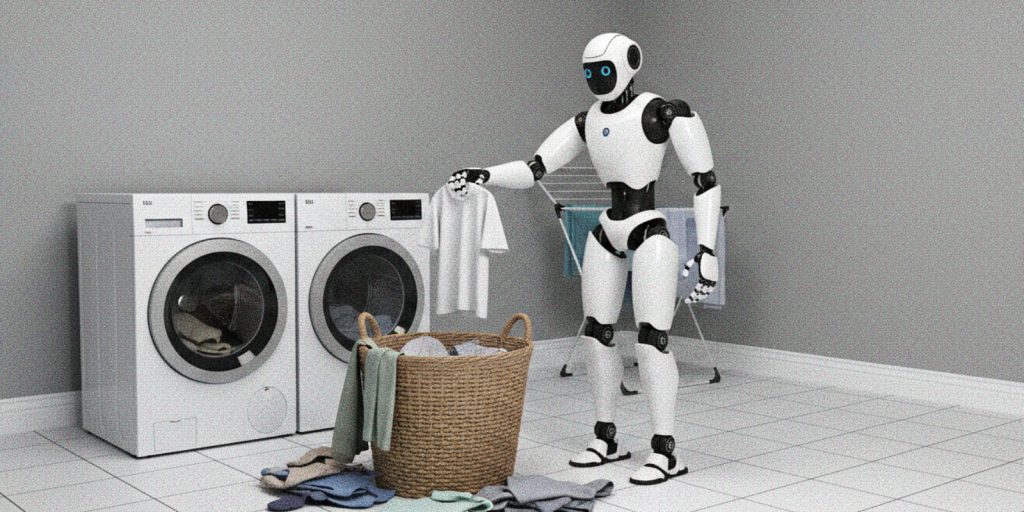
What if I told you the topic I had in mind was “Physical AI and Moravec’s Paradox”? But that seemed quite a bit technical, doesn’t it? But whether technical or not, the world as we know it is changing rapidly.
It’s Sunday evening. You’ve finally kicked off your shoes after a long, tiring week and sunk into the couch. There it is, that familiar laundry basket plopped right beside you, overflowing with socks that need pairing, crumpled shirts, and fluffy towels still warm from the dryer. Without even thinking, you start folding while chatting with your partner or scrolling on your phone. It’s pure autopilot; it just happens. So effortless it barely feels like a task; in fact, sometimes you complete it before realizing you did it. Honestly, a curious one-year-old could even watch you a couple of times and start copying the moves. We’ve all been doing this simple chore for years without a second thought.
Yet for decades, this everyday task that feels so basic to us was exactly what left artificial intelligence completely stumped.
While machines conquered chess in the 1990s, diagnosed diseases, and wrote poetry, they stumbled like toddlers when asked to grip fabric, judge folds, or navigate a cluttered table. This is Moravec’s Paradox, first observed by roboticist Hans Moravec in the 1980s: AI finds what we call “hard” (abstract reasoning, complex calculations) surprisingly easy, but what we spent millions of years perfecting, perception, mobility, and everyday physical dexterity, remains maddeningly difficult.
The paradox made sense. Our brains didn’t improve to play Go or optimize supply chains; those came late. But walking, grasping, sensing a wrinkled shirt? Those skills were hard-won over eons of survival. Robots, born in code, had no such evolutionary cheat code.
Until physical AI arrived.
Today, the script is flipping at breakneck speed. Embodied intelligence, robots that don’t just compute but move, sense, and act in our chaotic real world is surging. Physical AI isn’t a distant dream; it’s shipping by the thousands, dominating factories, rescue ops, and now prime-time television. The global physical AI market, valued at $5.23 billion in 2025, is projected to explode to $49.73 billion by 2033.
Start in China, where Unitree Robotics turned the paradox on its head. Their Go2 robot dog, affordable at just $1,600 has captured over 60% of the world’s legged robot market. By 2025, Unitree had shipped more than 5,500 pure humanoid robots globally, ranking No. 1. And just two nights ago, these exact Unitree humanoids stole the show on China’s Spring Festival Gala, performing death-defying acrobatics, perfect backflips, and nunchuck kung fu routines live in front of one billion viewers. A year ago, they could barely wave a handkerchief. Now? Explosive physical precision that headlined the biggest TV event on Earth.
Cross the ocean to Tesla. Optimus, the humanoid built on the same AI that powers Autopilot, is already walking factory floors with improved dexterity. Elon Musk’s team targeted thousands of units internally in 2025, with Gen 3 set for mass-production reveal in Q1 2026. The vision? Millions of these bots are folding laundry, sorting dishes, and freeing humans from drudgery.
Then there’s Figure AI, the U.S. startup valued at nearly $39 billion after massive backing from OpenAI, Microsoft, Nvidia, and Jeff Bezos. Their Figure 02 didn’t just demo, it worked. Deployed at BMW’s Spartanburg plant, these humanoids loaded over 90,000 sheet-metal parts and helped assemble more than 30,000 X3 SUVs, with 99%+ accuracy. Powered by their Helix model, they now fold laundry and load dishwashers in fluid, human-like sequences.
And don’t sleep on America’s robot-dog pioneers. Boston Dynamics’ Spot, the agile quadruped that’s climbed stairs, opened doors, and inspected hazardous sites, has over 2,000 units in operation worldwide. More than 60 bomb squads and SWAT teams across the U.S. and Canada rely on it for armed standoffs and chemical incidents.
The storytelling arc is clear: AI tackled our “hard” problems first, because code loves clean logic. Now, with better sensors, reinforcement learning from human videos, and massive computing, it’s conquering the physical world we take for granted. The laundry pile? Robots are already folding it. The dangerous factory job? Humanoids are handling it. The rescue mission in the rubble? Robot dogs are leading the way. And Unitree’s prime-time backflips? They just proved the future is here.
This isn’t hype. It’s happening in 2026. Physical AI is dominating because it solves the last mile of intelligence: embodiment. Soon, your home robot won’t just chat like ChatGPT, it’ll quietly sort your socks while you sip coffee.
But as these breakthroughs light up the world, one vital question lingers, especially here at home in Africa:
Where are we?
Will we once again be the consumers, scrolling videos of Unitree backflips and Tesla bots, importing someone else’s future?
Or will we finally become the builders, pouring bold investments into our own labs, our brilliant engineers, and robotics solutions forged for African realities?
The choice is ours.
Right now.
Today.
Let’s choose to build.
The paradox isn’t broken yet. But it’s cracking wide open. And when the final fold lands perfectly in the drawer, we’ll look back and realize: the easiest tasks for us were always the hardest for machines. Until they weren’t.